

Last Updated: November 5, 2026
Quick Summary
Sibling outfits that are not identical work best when you build a shared color palette first, then let each child wear a different garment cut in the same fabric. Coordinating on color, print, or fabric keeps the group unified without buying the same outfit twice. A navy tartan longall, bubble, and twirl dress read as one ensemble.
- Start with a palette of two or three colors before buying any garments.
- Tonal palettes suit spring and summer, while complementary palettes carry holiday photos.
- Keep one pattern large and one small so mixed prints read as intentional.
- A sibling capsule targets three tops, two main garments, and one layer per child.
- Check each size chart separately, since a 2T longall and a 2T dress fit differently.
Table of Contents
- Why Coordinating Beats Twinning for Sibling Outfits
- Build a Shared Color Palette First
- Sibling Matching Outfits Boy and Girl Without the Same Garment
- Mixing Textures, Prints, and Patterns Without Clashing
- Brother and Sister Matching Outfits for Pictures That Photograph Well
- Matching Toddler and Baby Outfits Boy and Girl: Sizing and Practicality
- Capsule Wardrobe and Hand-Me-Down Coordination
- Shop the Navy Tartan and Red Plaid Collections
- Frequently Asked Questions
Why Coordinating Beats Twinning for Sibling Outfits
Sibling outfits that are not identical photograph better, wear longer, and suit each child's body and personality. Coordinating means building a shared look from a common color palette, then letting each child wear a different garment cut.
Twinning is easy to shop, but identical garments on a 6-month-old and a 6-year-old rarely fit either well.
Below, we break down seven coordinating approaches, from color palettes to capsule wardrobes, so you can plan a unified look without buying the same outfit twice.
The Difference Between Matching and Coordinating
Coordinating is the practice of dressing siblings in separate garments that share color, print, or fabric so they read as one group. Matching means identical pieces. Coordinating allows a longall for him and a twirl dress for her in the same plaid.
Build a Shared Color Palette First
Start with color, not garments. A palette of two or three colors gives you a rule for every purchase and prevents mismatched clutter.
For holiday dressing, a navy, red, green, and white tartan does the work for you. Every piece in that plaid already shares the same four colors, so a longall, a dress, and an oxford all read as one ensemble.
Tonal, Complementary, and Contrast Approaches
Three palette structures cover nearly every sibling group:
- Tonal: one color in different shades, such as navy and light blue. Calm and easy to photograph.
- Complementary: colors opposite each other on the color wheel, such as red and green. Festive and high-contrast.
- Contrast: one strong color against a neutral, such as red plaid with white or khaki. Sharp and modern.
Tonal palettes suit spring and summer. Complementary palettes carry holiday photos. Contrast works year-round and is the easiest to build from pieces you already own.
Sibling Matching Outfits Boy and Girl Without the Same Garment
The strongest sibling matching outfits boy and girl pairs share a fabric, not a silhouette. He wears the plaid in a garment built for his body. She wears the same plaid in a cut built for hers.
Take the navy tartan story. A boy's Navy Tartan Longall is fully lined, with wooden shoulder buttons and snaps at the legs.

For families planning several boy-girl pairs, our big brother and big sister collection gathers coordinating pieces in one place.
Here is how a three-child group could be mapped in one plaid:
Child |
Garment |
Why It Works |
|---|---|---|
Baby girl, 9 months |
Navy Tartan Bubble |
Snaps at the legs for quick changes |
Toddler boy, 2T |
Navy Tartan Longall |
Fully lined, snaps for diapers |
Older sister, size 6 |
Navy Tartan Twirl Dress |
Smocked bodice, room to move |
Mixing Textures, Prints, and Patterns Without Clashing
Texture keeps a coordinated group from looking flat. Two children in the same plaid can still look distinct if one garment carries velveteen trim and the other smooth cotton.
Start with a fabric inventory before you buy. A coordinated group usually reads best with two surface types rather than four.
The navy tartan collection shows this in practice. The collar dress has a navy velveteen Peter Pan collar and velveteen sleeve trim. The longall is cotton plaid with wooden buttons.
Pattern Scale: The One-Large-One-Small Rule
Pattern mixing follows one rule: keep one pattern large and one small. A bold tartan paired with a fine stripe reads as intentional. Two bold patterns of equal scale read as noise.
Scale is easier to judge in inches than adjectives.
A common pattern is to build the group around one large plaid, then use small-scale patterns only as layers.
Sheen and Weight: The Part Most Guides Skip
Sheen matters as much as print. Velveteen and satin catch light, while cotton plaid absorbs it. If every child wears high-sheen fabric the group looks costumed; if every child wears matte, it looks flat.
Fabric weight should follow the child, not the photo. A fully lined longall suits a fall or winter event.
Watch out: matching the pattern but mismatching the weight is the most common texture mistake.
A Worked Three-Child Example
Here is how the surfaces stack for a three-child group in one navy tartan:
Child |
Main garment |
Surface |
Secondary surface |
|---|---|---|---|
Baby girl, 9 months |
Navy Tartan Bubble |
Smooth cotton plaid |
Velveteen collar |
Toddler boy, 2T |
Navy Tartan Longall |
Smooth cotton plaid |
Wooden buttons, no sheen |
Older sister, size 6 |
Navy Tartan Twirl Dress |
Smooth cotton plaid |
Velveteen bodice trim |
The plaid stays constant across all three. Velveteen appears on the two children where it reads at photo distance, the baby's collar and the older sister's bodice, and the toddler stays matte so the group doesn't look like a catalog spread.
When to Break the Rule
There is one case where two large patterns work: when they share an exact color. A large tartan and a large buffalo check in the same two colors read as a family because the palette does the linking. Reserve this for close-up portraits or older children who can carry more visual weight, since the group can look busy in a wide shot.
Brother and Sister Matching Outfits for Pictures That Photograph Well
Brother and sister matching outfits for pictures work best when the plaid sits near both faces.
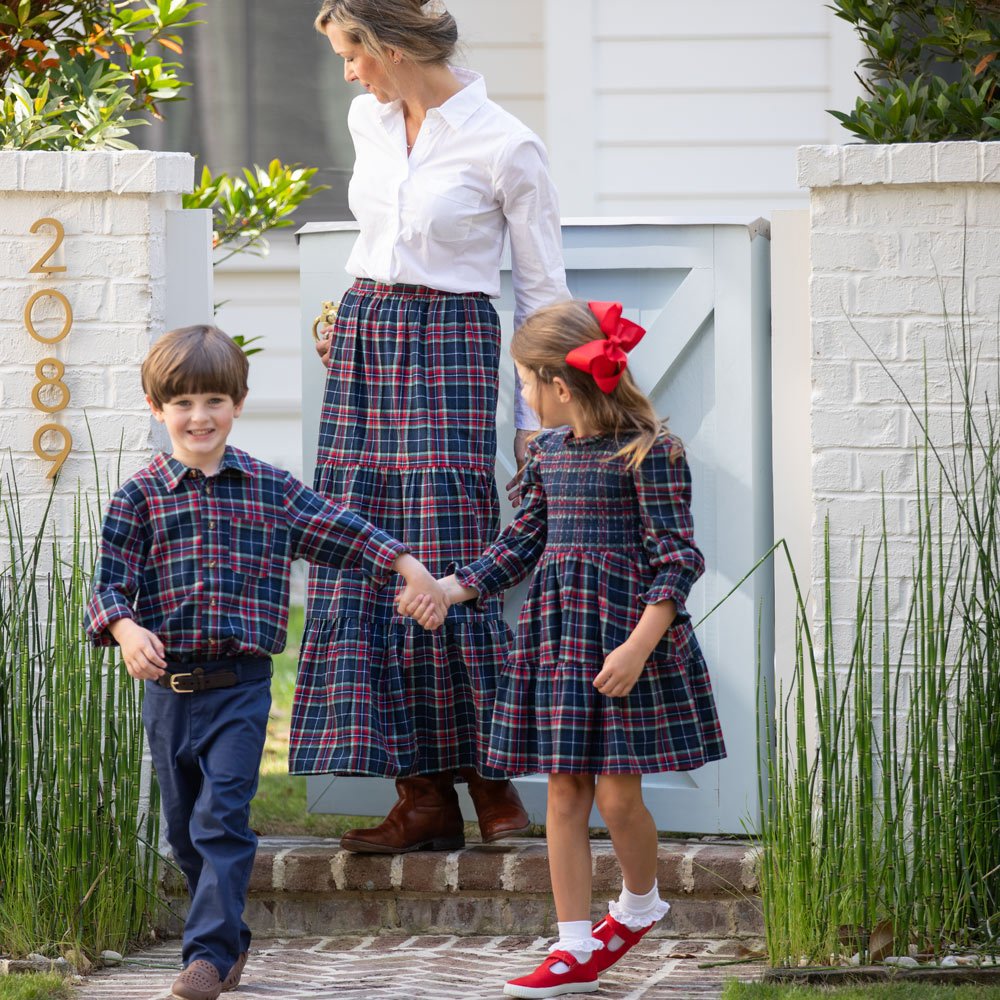
Snaps and back buttons help keep a bubble or longall in place. A smocked bodice is part of the Navy Tartan Twirl Dress design.
For the girl's side of a photo-ready pair, the Navy Tartan Collar Dress pairs with the boys' tartan pieces without repeating the same garment.

Matching Toddler and Baby Outfits Boy and Girl: Sizing and Practicality
Matching toddler and baby outfits boy and girl come down to two things: the size chart and the closure system. A dress with custom covered back buttons is a feature of the listed dresses.
For a baby joining older siblings in navy tartan, the Navy Tartan Bubble has leg snaps and a navy velveteen Peter Pan collar.

Capsule Wardrobe and Hand-Me-Down Coordination
A shared palette does something practical that twinning cannot: it survives hand-me-downs. When every piece in a collection shares the same plaid or color family, an outfit outgrown by one child still coordinates with what the next child owns, the capsule approach applied to siblings.
What a Sibling Capsule Actually Contains
A workable sibling capsule is smaller than most parents expect. The target is three tops, two bottoms or main garments, and one layer per child, all inside one palette. That is enough to produce a full week of distinct combinations without a single identical outfit.
The math is the reason. Three tops and two main garments give six combinations per child; across two children that's twelve coordinated looks from five pieces each.
Build the capsule in this order:
- Pick one plaid or one two-color palette for the season.
- Buy each child's main garment in that plaid, a longall, a bubble, or a dress, depending on age.
- Add two tops in the same palette but a different surface, such as a fine stripe or a solid knit.
- Add one neutral layer per child in white, cream, or khaki.
- Stop. Resist the urge to add a second plaid until the first capsule has been worn through.
How Hand-Me-Downs Fit the Capsule
They succeed when the palette is fixed, because an outgrown plaid longall still matches the younger child's plaid dress, neutral shirt, and knit layer.
Buy the youngest child's core pieces in the same plaid the older children already own, rather than starting a new collection each season.
A fixed palette is what makes that reuse possible, because a hand-me-down only works if it matches something the next child already owns.
Cost and Wear Math
A capsule lowers cost per wear in a way twinning cannot.
The same logic answers a fair question we hear often: whether the styles will look dated in a few years.
Seasonal Rotation
Rotate the capsule rather than replacing it. In fall and winter, the plaid main garments carry the group and the neutral layer is a knit. In spring, keep the same plaid but swap the knit for a cotton collared shirt and add a lighter main garment in the same palette.
That is the difference between a capsule and a collection. A collection is bought once for a photo. A capsule is a system that absorbs new sizes, new siblings, and hand-me-downs without breaking the coordinated look.
Shop the Navy Tartan and Red Plaid Collections
The fastest way to build a coordinated sibling group is to shop one collection at a time. The matching family Christmas outfits collection gathers the navy tartan and red plaid pieces in one place, so you can pull a longall, a dress, and a bubble that already share a palette.
A few practical notes before you order. Check each size chart separately, because a 2T longall and a 2T dress do not fit the same way.
Frequently Asked Questions
How can I coordinate sibling outfits without looking too matchy?
Pick one shared element and vary everything else. A common color palette, like navy, red, and green, ties the looks together while different garments keep each child distinct. For example, pair a Navy Tartan Longall at $39.00 with a Navy Tartan Twirl Dress at $49.00: same plaid, different silhouettes. Add a solid layer, such as a white collared shirt or a cardigan, to break up the pattern and give each outfit its own personality.
What colors look good together for sibling photos?
Stick to two or three colors and repeat them across both outfits. Navy, red, and green work well for holiday photos because they read as classic and timeless. Tonal looks, where siblings wear different shades of the same color, also photograph cleanly. Avoid introducing a bright new color in only one outfit, since it pulls the eye and breaks visual harmony. If you want contrast, use a neutral like white or khaki as the buffer.
Can siblings wear different patterns in family photos?
Yes, as long as the patterns share a color story and differ in scale. A large plaid on one child and a small print or solid on the other keeps the ensemble cohesive without competing. Keep one pattern as the anchor and let the second child's outfit echo its colors in a solid or texture. Two busy patterns at the same scale tend to clash in photos, so vary the size and keep the palette tight.
How do I coordinate outfits for a toddler and a baby?
Start with the baby's garment, since bubbles and rompers have fewer styling options, then build the toddler's look around its colors. A Red Plaid Bubble at $40.00 pairs naturally with a Red Plaid Collared Dress at $44.00 or a Red Plaid Oxford at $33.00. Choose pieces with snaps at the legs for quick changes, and size up where growth is fast. Fabric weight matters too: keep both children in similar weights so neither looks out of season.
At what age should you stop dressing twins the same?
There is no fixed age, but many parents move toward coordinating rather than identical outfits once children start expressing preferences, often around age three or four. Coordinating lets each child keep a distinct silhouette, like a bubble versus a dress or a longall versus an oxford, while the shared plaid or color palette keeps the group unified. It also makes hand-me-downs easier, since pieces can pass between siblings without needing a full duplicate set.
Coordinating a group of siblings takes one decision, not ten: pick the palette, then let each child's garment follow their age and size. Shrimp and Grits Kids builds family collections around exactly that idea, with classic plaid pieces, matching sibling sets, and holiday styles made for photographs you will keep. Browse the navy tartan and red plaid collections, choose each child's size, and get the whole group dressed from one palette.
